Most homeowners think about changing their air filter only when something goes wrong — when the air smells stale, energy bills spike, or the HVAC unit starts running longer than usual. But HVAC technicians see the inside story every day: a neglected filter quietly forces the entire system into overdrive, and by the time the damage is visible, it's already expensive. Understanding why regular filter replacement matters — and what a 4-inch deep-pleat filter actually does — can save you money, protect your equipment, and improve the air your family breathes.
12x26.5x4 air filters aren't a generic commodity. Their 4-inch depth and extended surface area allow them to capture significantly more airborne particles between replacements compared to thin 1-inch filters. But that larger capacity also means they can hold more contaminants — and when they hit saturation, the consequences for airflow, indoor air quality, and HVAC performance are real and measurable. Knowing when and why to replace them is practical knowledge every homeowner benefits from.
TL;DR Quick Answers
How Often Should You Replace 12x26.5x4 Air Filters?
Standard household: Every 90 days
Pets or allergy sufferers at home: Every 45–60 days
Heavy pollen season or dusty environments: Check monthly; replace sooner if visibly dirty
MERV 8: Best for standard residential filtration
MERV 11: Recommended for allergy sufferers
MERV 13: Optimal for households with respiratory sensitivities
A 4-inch filter holds more than a 1-inch filter but still reaches saturation — and a saturated filter restricts airflow just as badly as a thin one
Top Takeaways
4-inch filters last longer, but not indefinitely — check yours monthly, especially during high-use seasons
MERV rating selection should match your household — pets, allergies, and health conditions all justify higher efficiency
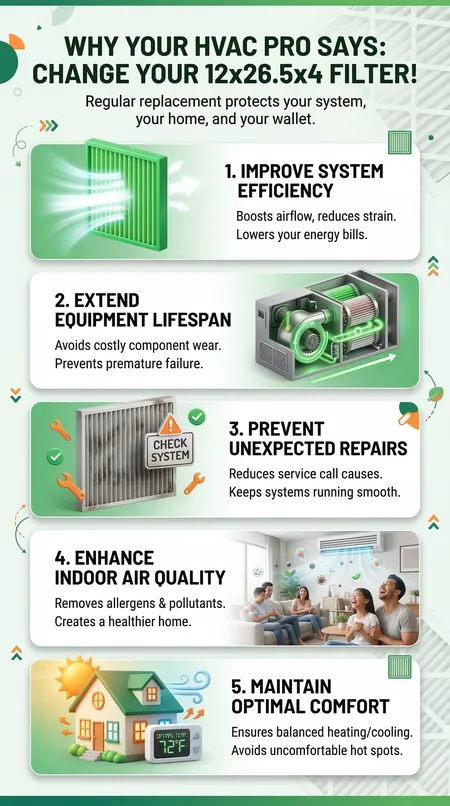
A clogged filter increases energy consumption and risks permanent equipment damage
Bypassed filtration is worse than no filtration — dirt accumulates on coils and internal components when airflow is forced around a saturated filter
Replacement intervals are a guide, not a guarantee — inspect your 12x26.5x4 filter visually and replace it based on actual condition, not just the calendar
Why Filter Depth and Change Frequency Both Matter
The 4-Inch Advantage — and Its Limits
A 12x26.5x4 filter has roughly four times the media depth of a standard 1-inch filter. More media means more surface area to capture dust, pollen, pet dander, mold spores, and fine particulate matter. It also means longer intervals between replacements under typical conditions.
But depth is not infinite capacity. Once the filter media loads up, the airflow restriction increases significantly. Your HVAC blower works harder, energy consumption rises, and the system begins pulling air around the filter rather than through it — bypassing filtration entirely.
What Technicians Actually See in the Field
HVAC technicians consistently identify clogged filters as a primary contributor to system inefficiency. When a filter clogs:
Airflow drops, reducing the system's ability to condition air throughout your home
Static pressure rises across the air handler, stressing the blower motor
Dirt bypasses the filter and accumulates on evaporator coils, degrading heat-transfer efficiency
Equipment lifespan shortens as components compensate for restricted airflow
A clean filter protects equipment. A dirty one quietly accelerates wear.
Why MERV Rating Matters for Your 12x26.5x4 Filter
The MERV (Minimum Efficiency Reporting Value) rating determines what size particles your filter captures:
MERV 8: Captures dust, lint, mold spores, and larger pollen particles — a solid baseline for most homes
MERV 11: Adds finer allergens like pet dander and dust mite debris — better for sensitive households
MERV 13: Captures fine particles including smoke, bacteria, and sub-micron particulates — hospital-adjacent performance for residential use
Higher MERV ratings increase filtration but also increase resistance. With a 4-inch filter, the deeper media offsets much of that resistance — which is why 4-inch deep-pleat filters at MERV 11 or MERV 13 are often more practical in residential HVAC systems than 1-inch equivalents at the same rating.
Household Factors That Shorten Filter Life
Not every home runs on the same cycle. These factors accelerate how quickly your 12x26.5x4 filter loads:
Pets: Dander and fur clog media quickly — replace every 45–60 days
Allergy or asthma sufferers: More frequent replacement helps maintain cleaner air and reduces symptom triggers
Dusty renovation work: Check and replace filters immediately after major indoor projects
Year-round HVAC operation: In warmer climates where systems run continuously, filters accumulate particulates faster than in seasonal climates
"In our experience, the most common cause of premature HVAC equipment failure is something entirely preventable — a filter that ran past its effective life. A 4-inch filter gives you extended capacity, but it still has a limit. When you push past that limit, you're not just breathing dirtier air; you're also shortening the life of equipment that costs thousands of dollars to replace."
Essential Resources on "12x26.5x4 Air Filters"
1. EPA Guide to Air Cleaners in the Home
A comprehensive homeowner-facing guide on selecting and maintaining HVAC filters, including MERV ratings, replacement frequency recommendations, and how filtration fits into a broader indoor air quality strategy.
Source: https://www.epa.gov/indoor-air-quality-iaq/guide-air-cleaners-home
2. EPA Indoor Air Quality: Air Cleaners and Filters Overview
The EPA's central resource hub for residential air filtration guidance, including links to technical summaries and consumer fact sheets.
Source: https://www.epa.gov/indoor-air-quality-iaq/air-cleaners-and-air-filters-home
3. ENERGY STAR: Heat and Cool Efficiently
ENERGY STAR's guidance on HVAC maintenance, including the direct relationship between clean filters and energy efficiency — with practical advice on replacement schedules.
Source: https://www.energystar.gov/saveathome/heating-cooling
4. ENERGY STAR: How to Keep Your HVAC System Working Efficiently
Step-by-step guidance on HVAC filter maintenance from ENERGY STAR, emphasizing monthly filter inspection and the energy and equipment-life consequences of neglected filters.
Source: https://www.energystar.gov/products/ask-the-experts/how-keep-your-hvac-system-working-efficiently
5. DOE: Air Conditioner Maintenance
The U.S. Department of Energy's guidance on air conditioner upkeep, with a specific focus on how dirty and clogged filters reduce airflow, hurt system efficiency, and cause premature failure.
Source: https://www.energy.gov/energysaver/air-conditioner-maintenance
6. EPA: The Inside Story — A Guide to Indoor Air Quality
A foundational EPA resource covering indoor pollutant sources, ventilation, and the role of HVAC maintenance — including filter replacement — in managing indoor air quality.
Source: https://www.epa.gov/indoor-air-quality-iaq/inside-story-guide-indoor-air-quality
7. EPA: MERV Ratings and HVAC Filtration for Residential Use
Technical EPA bulletin on MERV ratings, filter efficiency levels, and how to select the right filter for your HVAC system — including guidance on MERV 8, 11, and 13 performance thresholds.
Source: https://www.epa.gov/sites/default/files/2020-06/documents/2019.11_tech_bulletin_filtration.pdf
Supporting Statistics
1. Nearly half of a home's total energy use goes to heating and cooling. A dirty filter forces the HVAC system to work harder — directly inflating energy costs with every month it runs past its effective life.
2. The EPA estimates that some indoor air pollutants can be two to five times higher indoors than outdoors — and in some cases up to 100 times higher. Most people spend approximately 90% of their time indoors, making effective HVAC filtration one of the most impactful tools available for managing daily pollutant exposure.
Source: https://www.epa.gov/iaq-schools/heating-ventilation-and-air-conditioning-systems-part-indoor-air-quality-design-tools
3. A MERV 13 filter demonstrates at least 50% removal efficiency for the smallest particles tested — including fine particulates (PM2.5) identified as the greatest health concern. MERV 11 captures roughly 20% of particles between 0.3 and 1 micron. Choosing the right MERV level for your 4-inch filter slot isn't just about air quality — it's a direct health decision.
Source: https://www.epa.gov/sites/default/files/2020-06/documents/2019.11_tech_bulletin_filtration.pdf
What these numbers actually mean: The energy and health stakes of filter maintenance aren't theoretical. Every household that runs a clogged 12x26.5x4 filter is effectively paying more on utility bills, breathing more contaminated air, and shortening the lifespan of HVAC equipment — simultaneously. Regular replacement is the lowest-cost, highest-return maintenance action available to a homeowner.
Final Thought & Opinion
Changing your 12x26.5x4 air filter on a regular schedule is one of the simplest, highest-leverage maintenance decisions a homeowner can make. It protects equipment that costs thousands to repair or replace, keeps energy consumption in check, and directly affects the air quality inside a sealed home where your family spends most of their time.
The 4-inch deep-pleat design is a genuine advantage — it holds more, captures more, and extends service life compared to thinner filters. But that capacity still has a ceiling. Once a filter saturates, the benefits reverse: airflow drops, pressure increases, and the system that was built to protect your home starts working against itself.
The right approach: choose a MERV rating matched to your household's actual needs, inspect your filter monthly, and replace it based on what you see — not just what the calendar says. Four inches of quality filter media, properly maintained, does more for your home's air quality and HVAC longevity than almost any other single intervention.
FAQ on "12x26.5x4 Air Filters"
Q1: What does the 12x26.5x4 size mean, and does the filter need to fit exactly?
A: The dimensions — 12 inches by 26.5 inches by 4 inches — are the nominal size of the filter slot in your HVAC system. The actual filter is slightly smaller (typically 12x26.5x3.63 inches) to allow proper seating.
A properly fitted filter prevents air from bypassing the media
An ill-fitting filter — even slightly bent or crushed — compromises filtration entirely
Always verify your system's slot dimensions before ordering
Q2: How is a 4-inch filter different from a 1-inch filter of the same nominal size?
A: The depth difference is significant in practice:
More media depth = more surface area = greater dust-holding capacity
4-inch filters typically last up to 90 days; 1-inch filters often need replacement every 30 days
Higher MERV ratings are more practical in 4-inch filters because the deeper media compensates for increased airflow resistance
Q3: Can I use a higher MERV rating than what my system currently uses?
A:
Higher MERV filters restrict more airflow — your system's fan must be able to handle the increased static pressure
MERV 11 and MERV 13 in a 4-inch format are generally compatible with most residential HVAC systems
When in doubt, consult your HVAC manual or a licensed contractor before upgrading MERV ratings
Q4: What are the signs that my 12x26.5x4 filter needs to be replaced before the 90-day mark?
A: Replace sooner if you notice:
Visible gray or dark accumulation on the filter face
Reduced airflow from registers
Increased dust settling on surfaces throughout the home
Elevated energy bills without a change in thermostat settings
Musty or stale air odor
Q5: Do pets really make a meaningful difference in how often I should replace my filter?
A:
Yes — pet dander and hair are highly effective at clogging filter media quickly
Households with one pet: consider replacing every 60 days
Households with multiple pets: inspect every 30 days, replace every 45–60 days
Pet owners with allergy sufferers in the home should lean toward MERV 11 or MERV 13 for better dander capture
Ready to Protect Your Home's Air Quality?
Use what you know — your household size, pets, health needs, and how hard your HVAC system runs — to choose the right filter and build a replacement schedule that actually works. A consistent routine is the most effective thing you can do for your system and your indoor air.
Learn more about HVAC Care from one of our HVAC solutions branches…
Filterbuy HVAC Solutions - Weston FL
2573 Mayfair Lane Weston FL 33327
(754) 296-3528
https://maps.app.goo.gl/E3tjmKf5VSWYghGc7